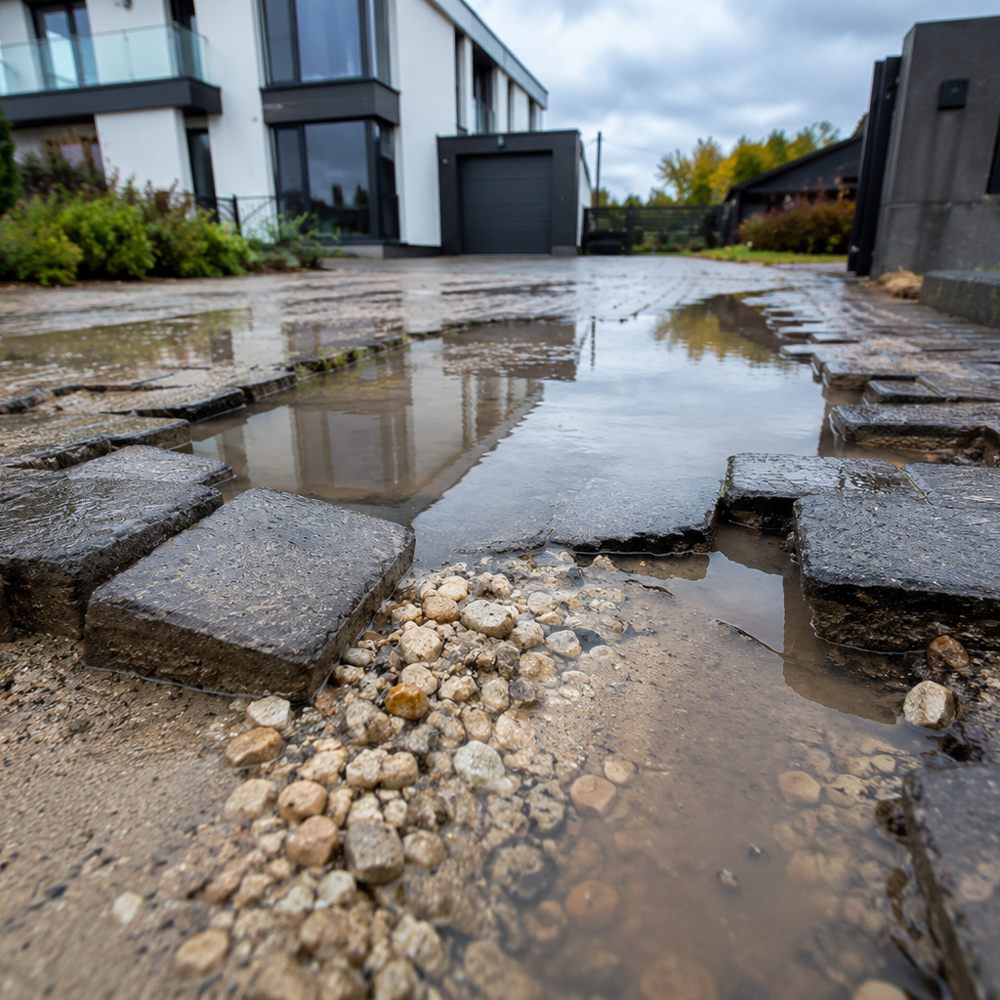
One heavy rain and a tidy yard can quickly turn into a mess of puddles, ruts and washed-out material. Standing water does not disappear, gravel piles start moving around, and the base settles so badly that the work has to be started again.
Although it may look like the problem comes from the sky, in most cases the real issue is in the ground: poorly prepared subgrade, insufficient slope, unevenly spread crushed stone and lack of the right equipment.
In landscaping and yard maintenance discussions, people often complain that after using fine screened gravel, holes appear after the first rain and the area becomes difficult to drive through. In other cases, water flows directly from the street into the yard and fills the drainage well, while clay soil turns into mud.
These examples show that the problem is usually not the rain itself, but poor base preparation.
A common solution is to pour another pile of gravel or crushed stone and hope it will stop the puddles.
Unfortunately, gravel that is too fine is not suitable for driveway or yard bases. It washes out easily and settles. On the other hand, 16–32 mm crushed stone is harder to compact and can be pushed aside when driven over.
Even the right material will not hold properly if it is poured in one thick layer. After rain, it can settle and lose stability.
A good base is built in layers. First, the topsoil is removed, the subgrade is compacted and geotextile is installed. Then a 10–15 cm layer of coarse crushed stone is added, followed by a 7–10 cm drainage layer, and finally a 10–15 cm surface layer of finer crushed stone mix.
Each layer must be compacted separately with a plate compactor or vibratory roller.
Fine particles work as a binder, so a mix of small and larger stone fractions locks together better and helps prevent water from penetrating the structure.
Another key factor is slope. Even a 2–3% fall helps direct water into drainage channels or pipes. If water enters the yard from a higher street level, a drain channel or drainage line along the road is needed. Otherwise, even the best crushed stone will eventually wash out.
A poorly prepared base settles after rain, creating ruts and water pockets. Gravel and crushed stone move to the sides, so the area constantly needs to be refilled and compacted again.
To prevent the problem from repeating, the base must be built in layers and shaped with the correct slope.
When paving is rushed, the base is often not compacted properly.
After rain, paving blocks can start moving, while washed-out sand escapes from the joints. A properly prepared base, with a coarse crushed stone layer and finer material on top, keeps paving stable and prevents movement.
Water often collects around edges, making them slippery and difficult to drive on without heavy machinery.
This usually means there is not enough slope or drainage, and the crushed stone has been spread unevenly.
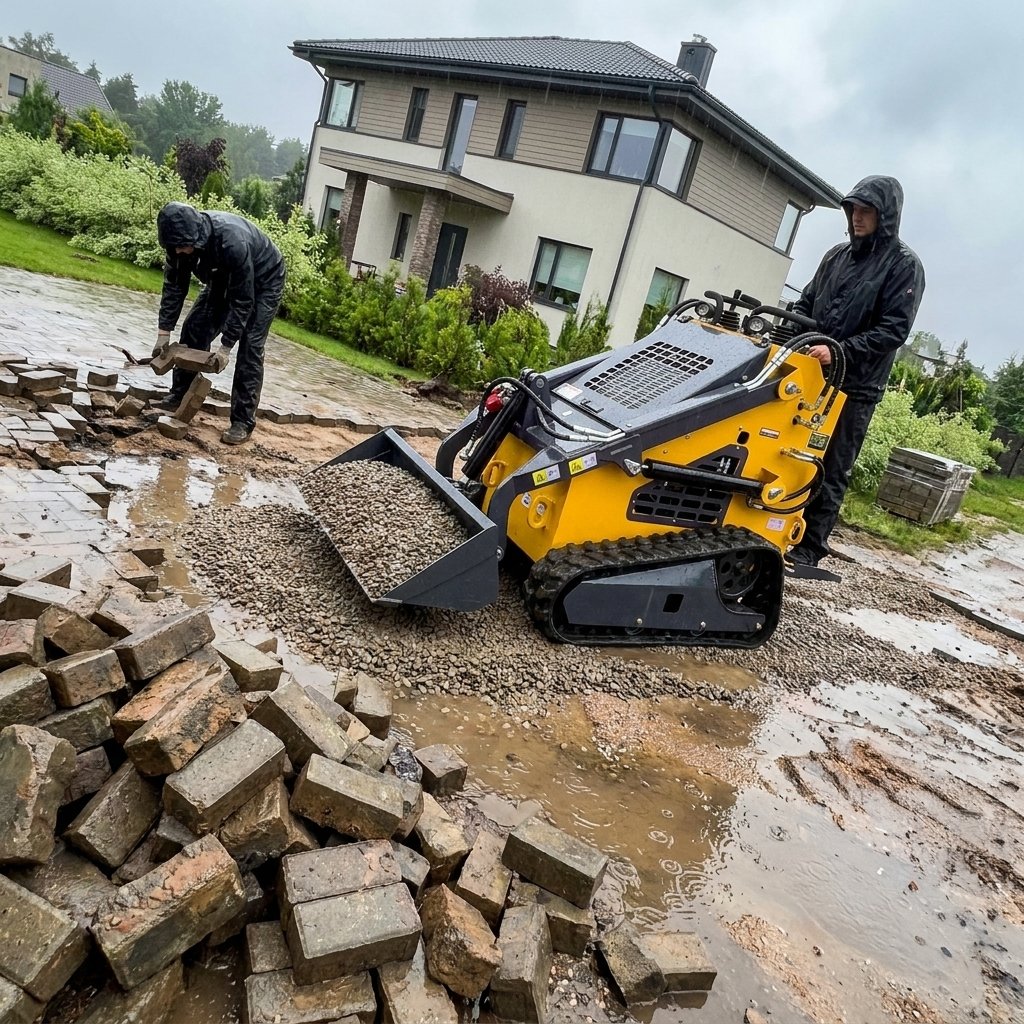
When shaping slopes, a mini loader with a bucket is useful because it can level the surface and push material into the right position.
Material delivered to a site is often dumped wherever there is space, and later it gets in the way of work.
It is more efficient to distribute the material around the site immediately, close to where it will be used.
For this, a loader is needed to quickly load and move crushed stone even in tighter yard areas.
The KR38 mini loader is not just a good-looking machine.
Its purpose is to shorten the time between material delivery and a compacted, usable base.
The 0.15 m³ bucket and tracked undercarriage allow the KR38 to quickly load gravel, crushed stone or soil and move it even in tight yard areas.
While you would still be struggling with a wheelbarrow, the loader can make dozens of trips back and forth.
The bucket is suitable for spreading crushed stone and gravel evenly.
This helps shape slopes, level ruts and create an even layer before compaction.
The KR38 can work like a small dozer. It can push material and level the surface, helping prevent rainwater from standing and damaging the work.
Thanks to its compact dimensions and tracked undercarriage, the loader can pass through gates and work near houses, greenhouses and areas where larger dozers would not fit.
Its triangular track design provides better grip on wet ground and helps reduce slipping.
| Work type | Is KR38 enough? | What to use additionally |
|---|---|---|
| Transporting and spreading gravel or crushed stone | Yes. KR38 can load, move and level gravel or crushed stone. | Not needed |
| Trench digging and drainage | No. A loader cannot efficiently dig narrow channels. | R10 or R13 PRO mini excavator for drainage trenching |
| Large material volumes and longer distances | Partly. The loader holds up to 0.15 m³, so it becomes slower over longer distances. | Dumper for carrying larger volumes over longer distances |
| Base compaction before surfacing | No. The loader spreads material but does not compact it properly. | Vibratory roller for areas over 100 m², plate compactor for smaller areas |
This breakdown shows that the KR38 is a versatile machine for many yard and construction tasks, but certain stages require specialised equipment.
A common mistake is judging only the loader price.
The better question is: how many times per season do you need to repair or rebuild the base?
If gravel transport and levelling happen several times per year, investing in the KR38 can pay off quickly. It saves time, reduces wheelbarrow work and removes the need to wait for rentals or crews delayed by weather.
If material only needs to be moved once per year, hiring equipment may be more logical.
But if the site is larger and requires regular maintenance, owning the machine becomes the smarter decision.
Rain reveals every weak point in a yard or construction site.
Puddles, ruts and washed-out crushed stone are usually the result of poor planning and an incorrectly prepared base.
But that does not mean you have to keep running around with wheelbarrows.
By preparing the subgrade properly, using geotextile, layering crushed stone, creating the correct slope and using reliable equipment such as the KR38 mini loader, the work can be done faster and with better quality.
If you are dealing with puddles, ruts or washed-out gravel in your yard or on a construction site, contact us.
Send a photo or describe what needs to be fixed, and we will check whether the KR38 is enough for your job or whether other equipment is needed.
Let the JEKPO team help you build a stable and tidy base so rain is no longer a problem, and puddles become a thing of the past.