Renting looks like the simple option. You call, you pay for a few days, you get the job done and forget about it. And that is true — until you count how many of those times add up over a season.
In this article we calculate what a single rental really costs, what the daily rate leaves out, and after how many rentals owning becomes cheaper. All figures come from the Lithuanian market, where JEKPO operates. Rates in your country will differ, but the method does not — every assumption is shown, so you can replace our numbers with your own.
A 1-tonne mini excavator rents for €85–100 per day including VAT on the Lithuanian market. Delivery and collection add from €70, and the refundable deposit runs €100–500. A realistic three-day rental with transport costs from €325.
One thing about us straight away, so we do not waste your time: JEKPO does not rent machines out — we sell them. The rental prices here are market data, not our offer. That is exactly why we can quote them openly: we do not compete in the rental market.
We collected these prices from the public price lists of three Lithuanian equipment rental suppliers on 28 July 2026. We compared machines of the same class — around one tonne, the size most often needed for a yard, a smallholding or a small site.
| Cost line | Market range |
|---|---|
| Daily rate (~1 t class) | €85–100 incl. VAT |
| Delivery and collection | €70–130 per rental |
| Deposit (refundable) | €100–500 |
| Attachments | usually charged separately |
Some suppliers do not publish prices at all and quote on request, so you only learn the real figure by calling. One detail matters: prices are not quoted the same way. Some show the amount excluding VAT, others including it. Before comparing offers, always check which number you are looking at.
The daily rate is only the starting point. The real invoice has several lines, and two of them are usually forgotten at the planning stage.
The machine is never parked where you need it. These charges vary more than anything else. Some suppliers quote one way only, so the real cost doubles. Others give a single figure for both directions. Outside city limits a per-kilometre charge is often added. Budget €70–130 per rental for transport alone.
A deposit is not a cost — you get it back. But it is money sitting outside your account for several days. Deposits on the market run from €100 to €500. If you need the machine several times a season, that sum is permanently tied up somewhere.
An excavator with a standard bucket will dig a trench. But if you need to auger post holes or break concrete, the attachment is usually rented and charged separately. Before you order, check what the base price includes — often it is just the machine and one bucket.
Let us work through a typical case. We take the assumption least favourable to us — the cheapest point on the market.
The gap looks small as long as it happens once. At six rentals a season, transport alone adds up to €420.
There is one more line nobody invoices you for — waiting.
Let us be straight about it: there is no fixed delivery time on this market. Some suppliers say they often deliver the same or the next working day. Others agree the timing case by case and commit to nothing specific.
That is the whole point. Not that renting is slow — sometimes it is very fast. It is that the timing is not fixed, so you cannot build your schedule around it. At the peak of the season the machine you need may simply not be free.
What does a day of standing still cost? Operated mini excavator work on the Lithuanian market starts at about €25/hour and reaches roughly €31/hour.
One qualification, so the number stays honest: this line applies to those who earn money with the machine. If you dig for yourself — on your own property or your own farm — you lose a weekend and the order of your work, not revenue. The amount is different, but the line is the same: waiting costs.
These are scenarios, not statistics. But anyone who has worked through a peak season knows what a week of waiting for a machine looks like.
Renting is not a bad thing. There are cases where it is clearly right, and it would be dishonest not to say so.
If at least two of those describe you, renting is probably the right answer. Read on only if renting keeps reappearing in your accounts.
Now a simple calculation — not in days but in rentals, because that is how people actually remember them. One rental costs €325. The JEKPO RIPPA R10 costs €6,050 incl. VAT (€5,000 excl. VAT), with free delivery anywhere in Lithuania. The €70 transport line that repeats with every rental simply does not exist here.
A few notes to keep the number honest. We excluded attachment rental, deposits and lost working days — including them brings the break-even closer. But we also excluded servicing and fuel for a machine you own. Those are real costs and worth knowing about.
And one more thing the calculation does not show: after the eighteenth rental that money stays with the rental company, while a machine you bought is still yours, with a resale value.
And one more thing the calculation does not show: renting spreads the cost across several seasons, while buying asks for the sum up front. If that sum is too much today, renting stays the right answer even after the break-even point has passed. But if the obstacle is cash flow rather than the amount itself, the machine can be bought in instalments through our finance partners — SME Finance, Inbank or ARTEA. The application is filled in online, the finance partner calculates the terms, and we only point you there; all payment methods are listed in the Payments section. The monthly instalment is then compared not with €6,050 but with the same rental line that repeats every season.
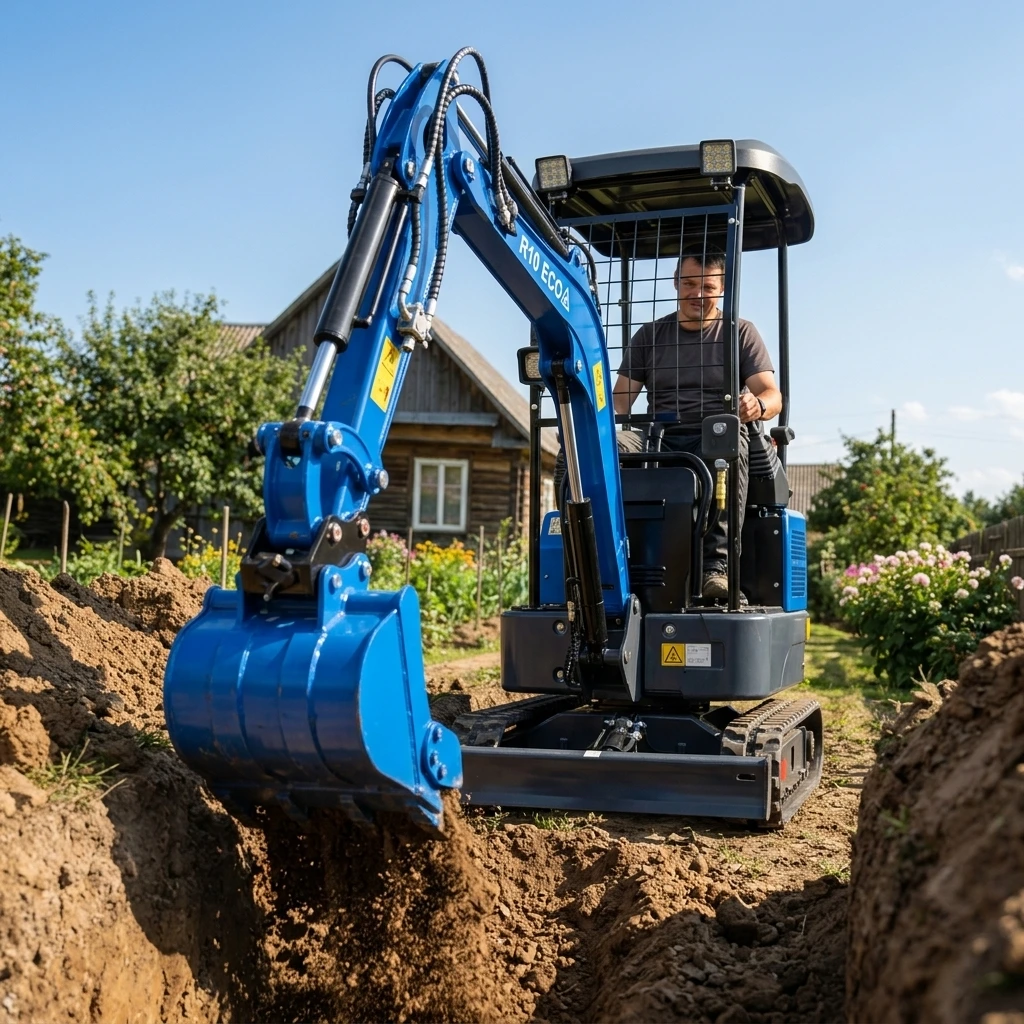
A number only means something when you know what stands behind it. The JEKPO RIPPA R10 is a 1-tonne class mini excavator built to work where larger machines do not fit.
| Specification | Value | What it means on site |
|---|---|---|
| Operating weight | 978 kg | You tow it yourself — no low-loader, no haulier |
| Digging depth | 1 933 mm | Foundations, drainage, deeper trenches |
| Width with tracks retracted | 912 mm | Fits through narrow gates and between buildings |
| Hydraulic flow | 18 l/min. | Auger, breaker and other hydraulic attachments |
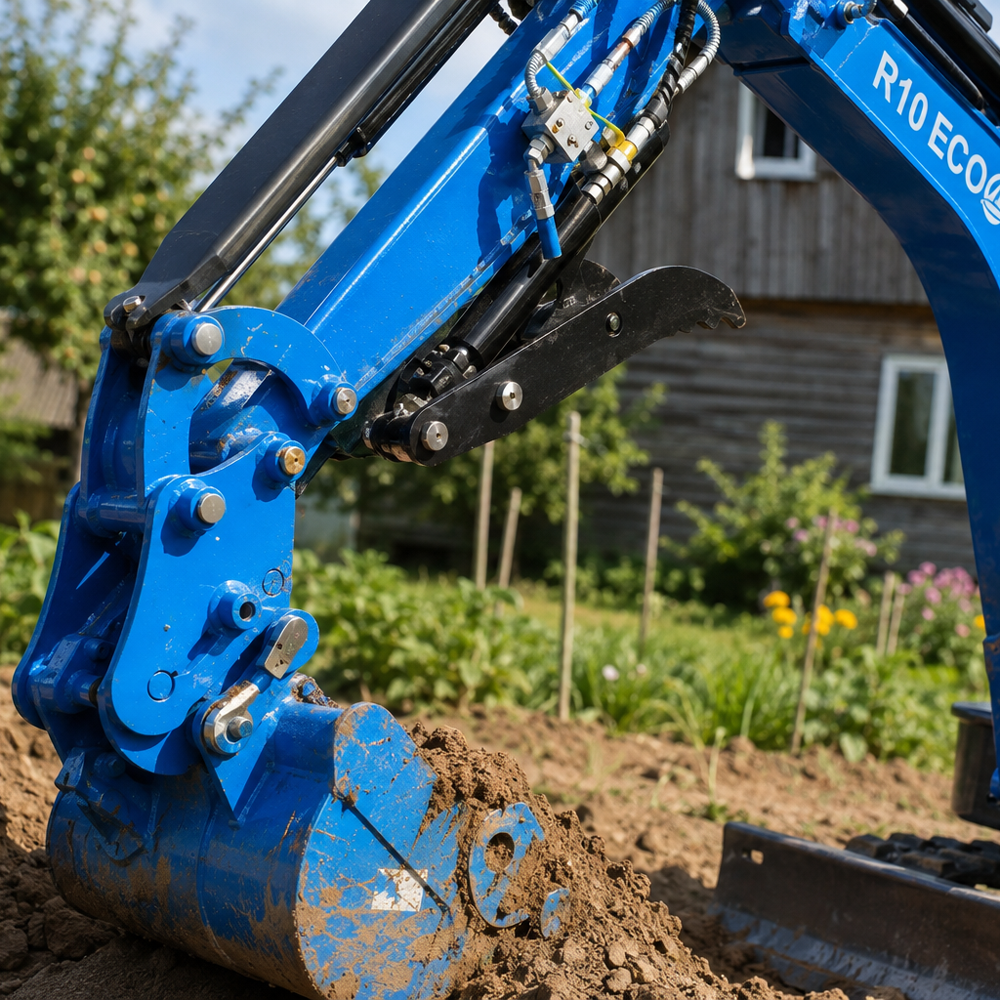
Standard equipment includes a bucket, joystick controls, a swing boom, expandable tracks, a hydraulic thumb and a mechanical quick coupler for attachments. Engine options: a 7.5 kW base diesel or a 8.2 kW Kubota.
Before choosing a model it is worth understanding what digging depth, access width and boom swing actually change on site, and whether the one-tonne class is enough for your work. If you are already leaning towards buying, the most common mistakes buyers make are also worth reading.
No complex analysis is needed. Four questions are enough:
If at least two of those answers bothered you, your break-even point is probably close. We ran a similar calculation when comparing whether it pays to do groundwork yourself.
This article uses Lithuanian market averages. Your own figure will differ — it depends on how often you rent in a season, where your sites are and what kind of work dominates.
If you simply need a machine for one job right now, go to a rental company — that will be faster. We do not offer rental. But if you are weighing up whether owning makes sense, that is where we can help.
Tell us how many times you have rented this year and for what work — we will calculate your break-even point. If it turns out renting is cheaper in your case, we will say so.
The machines can be inspected and tested in person in Šiauliai, Lithuania. Come and see how one works before you decide.
JEKPO, Ateities g. 2, Dainos, Šiauliai, Lithuania
Tel. +370 628 87 761 · info@jekpo.com
Rental price ranges were collected from the public price lists of Lithuanian equipment rental suppliers on 28 July 2026. The comparison uses the ~1 tonne class and the cheapest market point; attachment rental and deposits are excluded. Market prices change — check current rates before deciding. Prices outside Lithuania will differ; the method, not the figure, is what transfers.