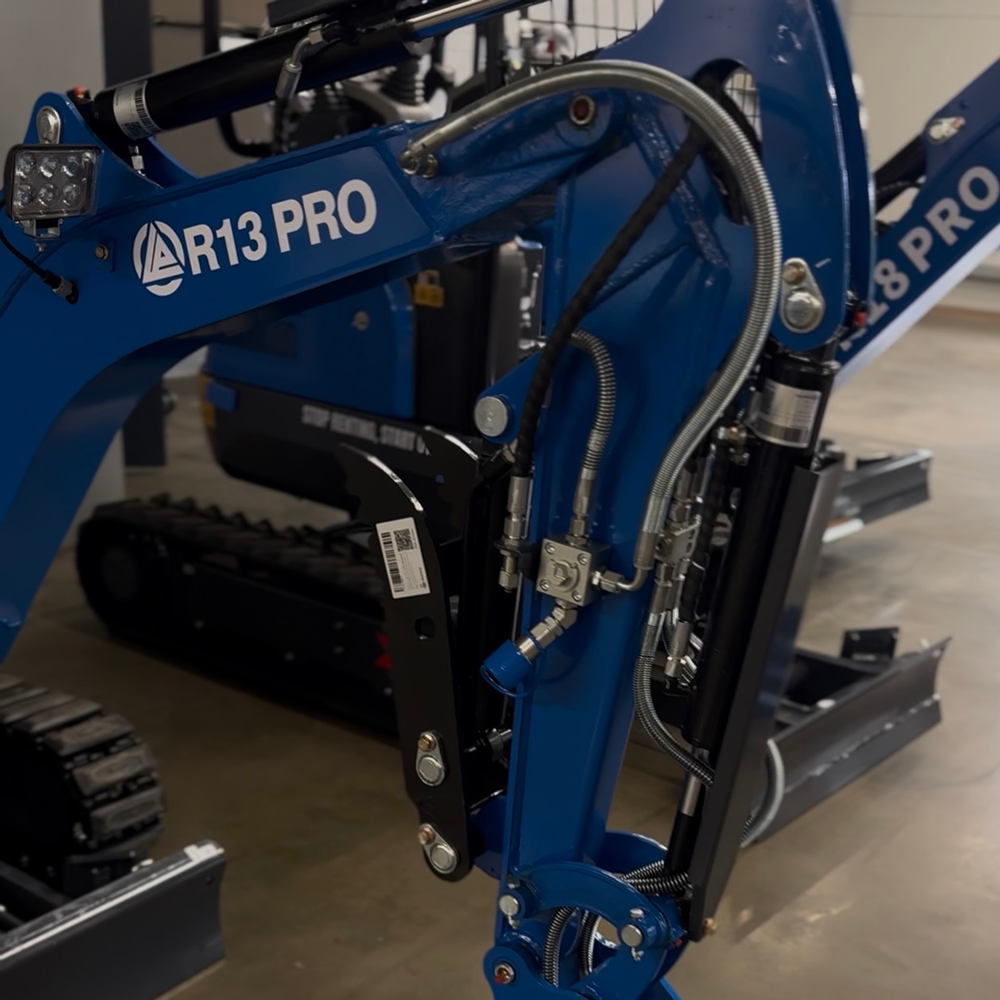
The RIPPA R10 and R13 PRO mini excavators are usually compared when someone already knows they need their own digging machine, but is still unsure about the size.
One model looks attractive because of its price and compact size. The other offers more power, a Kubota engine and higher productivity on site.
The key is choosing correctly.
A mini excavator that is too small starts slowing work down when the ground becomes heavier, trenches get deeper or jobs become more frequent than expected.
A machine that is too large for a small property may cost more, take up more space and never be fully used.
That is why choosing between the R10 and R13 PRO should not start with a price list.
It should start with a simple question:
What will this machine actually do throughout the season?
Will it mainly handle drainage, cables, irrigation systems and a few roots around a property?
Or are you already planning deeper trenches, heavier ground, more frequent projects and work beyond your own site?
Once the jobs are clearly defined, the difference between the R10 and R13 PRO becomes very obvious.
The RIPPA R10 is better suited for users who need a compact 1-tonne class mini excavator for a property, small farm and straightforward digging work.
The R13 PRO becomes the better choice when you need more stability, a larger bucket, deeper digging, a Kubota engine and more working reserve.
The RIPPA R10 is a compact 1-tonne class mini excavator designed for smaller, straightforward and frequently repeating jobs.
It weighs around 978 kg, has a digging depth of 1833 mm, bucket capacity of 0.014 m³, hydraulic flow of around 18 L/min and engine power of 8.2 kW.
This model works especially well on private properties, small farms and areas where manoeuvrability matters most.
If you need to run a cable for a gate, install an irrigation system, dig a drainage trench, fix water runoff or remove a few roots, the R10 is usually more than enough.
One of the biggest advantages of the R10 is its compact size.
The smaller footprint allows access near fences, greenhouses, foundations, narrow entrances and other places where larger machinery becomes inconvenient.
When there is already grass, paving, paths or a finished yard around the work area, a smaller excavator allows more accurate work and leaves less mess behind.
Another major advantage is availability.
The machine stays on your property or farm. A job appears, you start the machine and complete it immediately without arranging rentals or waiting for availability.
The R10 has clear limits.
If you plan to work regularly in heavy clay, dig deeper trenches or move larger amounts of soil, the smaller model starts slowing the workflow down.
The 0.014 m³ bucket means more digging cycles.
The 18 L/min hydraulic flow is ideal for lighter work, but performance slows in heavier soil conditions.
This is where the difference between the R10 and R13 PRO becomes noticeable.
If the machine will work not only on your own property but also on more frequent projects, it is worth considering a more powerful model with greater reserve capacity.
The RIPPA R13 PRO is a larger and more productive machine.
It weighs around 1300 kg, digs to 2100 mm depth, uses a 0.03 m³ bucket and includes a standard 400 mm bucket width. Machine dimensions are 2550 × 750 × 2300 mm.
The R13 PRO comes equipped with a Kubota D722 3-cylinder diesel engine producing 10.3 kW. Hydraulic flow is approximately 23 L/min.
These differences become very noticeable in real work.
More weight means greater digging stability.
A larger bucket moves soil faster.
Stronger hydraulics work better with attachments and maintain a higher working pace.
The R13 PRO is usually chosen by people planning more working hours, more frequent jobs or heavier ground conditions.
Kubota engines are valued in the mini excavator market for reliability and long-term durability.
When machinery works frequently, during longer days and under heavier load, this becomes very important.
If the excavator is mainly for seasonal property or farm work, the R10 is often a perfectly logical choice.
If the machine will work more frequently, during longer working days or on commercial jobs, the Kubota engine provides more long-term confidence.
A larger model does not automatically mean it cannot work in smaller areas.
The R13 PRO keeps a compact 750 mm width, allowing it to pass through narrow access points, between buildings, gates or close to fences.
This is very important for landscaping and private property work where larger machinery often does not fit or causes more surface damage.
The R13 PRO also features zero tail swing.
When working next to walls, fences or foundations, this becomes very useful because the rear of the excavator does not extend far beyond the tracks while rotating.
Pilot joystick controls improve accuracy and comfort during longer working days.
When the task is no longer a few metres of trench but extended digging work, operator comfort starts making a real difference.
The value of a mini excavator depends heavily on attachments.
The same machine can be very limited or highly versatile depending on configuration.
A narrow bucket is essential for drainage, cables and irrigation systems.
A wider grading bucket helps level soil and finish the area after digging.
A hydraulic thumb allows handling roots, stones, stumps and construction debris.
A quick hitch system allows faster attachment changes and reduces wasted time on site.
The R13 PRO makes sense when it is already clear that there will be a lot of work.
If deeper trenches, heavier digging, more attachment use or higher productivity are required, this model provides more reserve for future jobs.
The 0.03 m³ bucket moves soil faster.
The 2100 mm digging depth expands trenching capability.
The 23 L/min hydraulic flow improves attachment performance.
The Kubota engine adds long-term confidence.
The R10 makes more sense when jobs are smaller, clearer and mostly related to your own property.
If the main tasks involve irrigation systems, cables, smaller drainage work, landscaping or digging around a house, this model can handle the work perfectly without a larger investment.
It is also a good option for someone starting with smaller machinery and not wanting to overpay for power that will never actually be used.
Before choosing between the RIPPA R10 and R13 PRO, it is worth writing down the planned work clearly.
How deep will the trenches be?
How often will the machine work?
What type of ground is common on site?
Will the machine only work on your own property or also on external projects?
If the work is lighter and seasonal, the R10 is often the more practical option.
If there is more work, heavier ground and longer operating hours, the R13 PRO provides more speed, stability and long-term reserve.
The RIPPA R10 is a very good choice for private properties, small farms and recurring lighter digging jobs.
It is compact, manoeuvrable and practical for everyday smaller tasks.
The RIPPA R13 PRO is better suited when more power, deeper digging, a larger bucket and stronger hydraulics are needed.
It is the model for people planning to work more often, for longer hours and who want more reserve for future projects.
If you are considering which model fits your work best, contact the JEKPO team.
Tell us what jobs you plan to do, what ground conditions you work in and how often the machine will be used.
We will help you decide whether the RIPPA R10 is enough or whether it already makes sense to move up to the R13 PRO.